Friday, August 26, 2011

The Way of Grace


The nuns taught us there were two ways through life - the way of nature 
and the way of grace. You have to choose which one you'll follow.

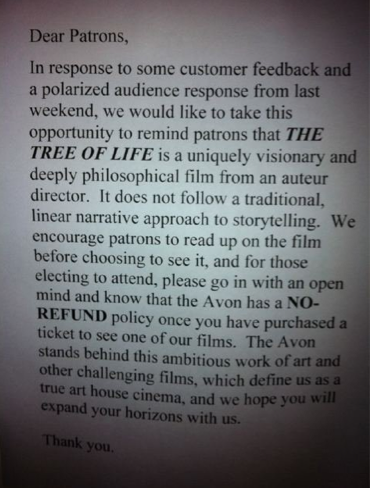
I've never written a movie critique before, but after watching the Tree of Life for a third time, I'm feeling particularly inspired. Sure there are many movies that some people like and some people don't (i.e. Saw VI), but never before have I experienced such a radical degree of polarization over a film. After arriving home from the second viewing, a neighbor staunchly commented that it was the worst movie she had ever seen. How's that for a movie review? Other people I know have snored their way through it and even left the movie theater in extreme consternation - partly because the theater staff wouldn't provide a refund. On the other hand, there is a certain type of people that has been moved to tears and profoundly affected by the emotional and existential significance of the subject matter. But how can this extreme contrast exist? How is it possible that we lie on such opposite ends of the spectrum of internal experience? I use the term experience because even if one doesn't understand the film the first time through, one is still capable of feeling its effect.

In other words, you don't have to fully understand it to be significantly moved. But how are we being moved exactly? What aspect of us is being moved? Could it be worthwhile to explore this? Could it be worthwhile to find out how to access this state more often? So what exactly is this state (for lack of a better term)?

Friday, August 12, 2011

Meditation: How to do it


Chaos is a friend of mine
-Bob Dylan

Before traveling to Thailand to learn meditation, I had no idea that my friends and family would be interested in ever practicing it. Since that trip however, I've had the pleasure of showing it to loved ones in various cities, including new friends here at Harvard and MIT. We are all motivated to learn meditation by something, perhaps curiosity at first, perhaps because we feel there is something missing from the way in which we experience daily life, perhaps we've come across a significant life event that becomes unmanageable, or perhaps it's due to something else. Whatever your motivation, below are a set of simple instructions (as simple as I could make them) that will show meditation to anyone willing to spare 5 minutes of their day.

I hope you find it useful.

Wednesday, August 10, 2011

The Grandest Illusion

The great obstacle is always the representation and never the reality
- Etty Hillesum

Preconceptions and misconceptions have engulfed the concept of meditation. Some people believe it's tied to Buddhism and cannot be detached from archaic supernatural beliefs. Others believe it's simply a tool to relax and reduce rampant stress levels in the mind and body. Still others who ponder it a bit more deeply - though still erroneously - argue that it detracts from our very human ability to experience the full spectrum of emotions. One common theme seems to unite the people who believe any or all of these things however - none of them have ever truly meditated. So what is it really about then?

It is about dispelling an illusion - the illusion that our subjective experiences are equivalent to objective reality.  

Say what?

Tuesday, July 19, 2011

Opening the Mind


Know Thyself
- engraved at the Temple of Apollo at Delphi

Many civilizations have regarded self-knowledge as the catalyst and indicator of wisdom. The path to self-knowledge is self-examination, but that is no longer a component of our education system as it once was. This is unfortunate by any account. In our modern westernized world, self-examination seems to have been limited to the areas of interpersonal counseling and few others.

Tuesday, July 5, 2011

The White Flag Hypothesis (2 of 2)


It is only after we have lost everything,
That we are free to do anything.

Underlying every human experience, mine and yours, there is a hidden but ever-present psychological struggle with existence itself. As we all know but seldom discuss, there is no way to win this struggle – we can’t help that our consciousness will cease to be at some point. Maybe sooner, maybe later. Given the futility and stress inherent to this phenomenon, we’ve become quite adept at hiding this primal dilemma of human life. The better we hide it or pretend it doesn’t exist, the better off we will be. Or so we think.

Sunday, July 3, 2011

The White Flag Hypothesis (1 of 2)


If you young fellows were wise, the devil couldn't do anything to you, 
but since you aren't wise, you need us who are old.  
- Martin Luther

As people age and the end of life comes clearly into view, something weird and interesting happens in the brain. Call it a "cognitive shift" or transcendence for now. This "shift" happens not only to old folks; but also to people who are afflicted by a terminal illness, experience the death of a spouse/child/best friend/sibling/parent, suffer an intense life-threatening accident, lose all of their possessions and/or wealth, experiment with psychedelic drugs, etc. (geez, all the cool stuff right?). See my previous post for some real world anecdotes. In essence, these events act like powerful psychological triggers in the brain, often resulting in a wildly transformative shift away from current views of ourselves, of other people, of deeply held values or beliefs, and of our very understanding of existence. Whew!

Sunday, June 26, 2011

The View from Outside


If we concern ourselves with meaning, society provides us with little direction.

I've always been curious, perhaps uncommonly so. When I was about 12 or 13 years old, I remember wanting to conduct an experiment interviewing older people who were nearing the end of their lives - say, 80 years or older. The setting wouldn't matter (nursing homes, family homes, in a cabin in the forest, etc.) but mental clarity certainly would. The main question I wanted to ask them was, "Having lived a 'full life' and possessing more wisdom than most, what would you say are the best ways to spend one's time?" In other words, "What truly matters?" I always had an underlying feeling that the various life pursuits advocated by family, school, and television were cleverly constructed distractions from what truly matters. The real answer to that question may produce a considerable degree of anxiety, but I figured these old wise folk - with less concern for social constructs - could shed some light on it.