Thursday, August 1, 2013

The Limits of Choice


 Attachment is the great fabricator of illusions
- Simone Weil

It has been difficult to gather enough motivation to write another entry. I am wondering why. Looking back over previous posts I see a single-point focus on breaking free from the influence of others... but now that intention is gone. In its place are a variety of interests, a variety of paths, a variety of truths and new perspectives. But which of these should I communicate via this blog? Hesitation. The single-point focus is now without a point. Surely the last two years at Harvard have revealed many things to me... but were these things important? I find it hard to say. Even if they were, I now feel that we each must follow our own path in life. Our own path of learning, of experiencing, and of doing neither. We are free to look deeper, but only when we are ready to do so. Attempting to influence another may be misguided and, in the end, futile. Perhaps in breaking free from the influence of others, one also breaks free from the urgency to influence others. Perhaps I had been trying to influence and guide others all along... without really knowing the way.

*****

I will be attending the annual three-month meditation retreat at the IMS in Massachusetts. We humans have this intriguing and perfectly natural propensity to attach to particular lifestyles, particular worldviews, particular ideologies... or, put more broadly, particular ways of understanding reality. By attaching, we inadvertently imprison ourselves to that particular way of understanding... limiting our perspective to a mere slice of the whole. Religion is a useful metaphor here. By psychologically attaching to (i.e., believing in) Catholicism, for example, we limit our openness and, hence, understanding of other religions. In doing so, we deprive ourselves of the bigger picture, of that kernel of truth that lies waiting. This applies not only to religious traditions, but to practically any conscious or unconscious value, idea, principle, belief, opinion, comparison, judgment, understanding, etc. If truth is our goal, then our natural propensity to attach is the barrier. If in a hallway with twenty doors you walk through one, the others disappear from view. If enough time passes, those old doors disappear from memory too. Meditation is one of several curious life experiences that can pull you back into that hallway. Death, drugs, and great loss are others.

And now, standing once again in the hallway of doors, how do you choose? You do not.

Friday, September 28, 2012

Slowly, in the light


The compensation of growing old, Peter Walsh thought, coming out of Regent's Park, and holding his hat in hand, was simply this: that the passions remain as strong as ever, but one had gained -- at last! -- the power which adds the supreme flavour to existence -- the power of taking hold of experience, of turning it round, slowly, in the light.

Virginia Woolf, Mrs. Dalloway

Originally, this blog was intended to chronicle a career change. I now think it served a much greater purpose.

In my early/mid twenties, I seemed to value what society valued: a hefty paycheck, an impressive job title, an enviable rolodex of "powerful people", a fancy car, a chic apartment, an athletic physique, etc. I valued this identity for the message it transmitted to the outside world: "Hey everyone, I have my shit together." That was nice. But then something happened. A quiet voice inside of me had been whispering, "yo dude, you don't truly value any of these things." And what began as a harmless whisper grew into an incessant blare, leaking a corrosive inauthenticity into my thoughts, decisions, and actions. Only my feelings, as harrowing as they had become, seemed to harbor the final remnants of truth. I was not happy.

Friday, May 25, 2012

The Great Imbalance


The intuitive mind is a sacred gift and the rational mind is a faithful servant. 
We have created a society that honors the servant and has forgotten the gift.
-Albert Einstein

As preposterous as this may sound, each of us are in fact two. The presence of this division of human experience may become one of the greatest psychological discoveries of our time.

The pop-psych understanding that one part of our brain handles "reason" while the other part handles "emotion," is not entirely accurate to reality, but it is pretty damn close. For simplicity's sake, let's call reason the "left side" and emotion, the "right side." Again, remember that these labels are oversimplifications of the truth. Allow me to add a little more meat to the bones of reason and emotion.

Thursday, January 26, 2012

On Kindness and Worms


The fault, dear Brutus, is not in the stars, but in ourselves.
- Shakespeare

Lately I have been curiously attending to my interpretation of experiences. The phrase "things aren't always as they seem" is wrong; for things are indeed always as they seem. Things are always something other than what they seem, as well. All interpretations are valid... as well as none. Kindness to others, and interestingly also to ourselves, depends on our ability to relieve our own perspectives from their place atop golden pedestals.

I'd like to share the following story recently recounted by a Harvard professor.

Tuesday, January 17, 2012

Happiness on Fire


I hold that to need nothing is divine, and the less a man needs
the nearer he does approach divinity
Socrates

Happiness. I have reoriented my life towards understanding it and what have I learned? The desire to be happy does not lead to happiness; and in this paradox lies the key.

Although some of the following concepts are also found throughout literature and philosophy, they may not be understood easily or quickly as they require some unweaving of established perspectives. Let's unweave.

Friday, January 6, 2012

The Broad Road Through


If you would be a real seeker after truth, 
it is necessary that at least once in your life 
you doubt, as far as possible, all things.
-Descartes

I had a difficult time accepting this aspect of myself, but compared to the average person, I am really bad with details. I’m not sure if it’s because I find them boring or because I’m simply bad at paying attention to them. Due to this, I’m not good at recalling facts or dealing with practical matters. I’m beginning to accept however, that I have substituted that skill with a different one.

Sunday, December 18, 2011

The Inferiority Radar

Girl at the Mirror, courtesy of Ken Worley

Better is the enemy of good
Voltaire

We all strive to be better. We are continuously encouraged to improve, and sometimes even pressured to do so against our will. We've embraced the idea of lifelong enhancement as an unquestionable aspect of what it means to be human. And why shouldn't we? It seems noble enough, and largely preferable to the alternative, for a person that quits this struggle for betterment is peppered with negative adjectives such as lazy, unambitious, useless, good for nothing, etc. If we read between the lines however, we encounter a surprising paradox.

Thursday, December 8, 2011

Wisdom of the Wrinkled


If the stars should appear but one night every thousand years, 
how man would marvel and stare.
-Ralph Waldo Emerson

I've always been fascinated by the sometimes "strange" life advice that older people give. It hasn't been until this semester - studying psychology as a second career - that I've learned why that is. A profound change occurs in how we perceive the world as we grow older (60 years and up), and I think most of us intuitively know this in some way or another, whether or not we've studied psychology. So what changes exactly? Simply put, we turn our attention to things that REALLY matter in life. Why do we do this? Because at some point a certain fact of life hits us full force -- our time is limited.

Monday, October 31, 2011

Evolved to Chill


If you desire many things, many things will seem few.
- Benjamin Franklin

Train for a marathon and your endurance increases. Go on a diet and your body learns to consume fewer calories. Ride a bicycle everyday and your legs become stronger. The human body adapts to the environments we subject it to... and so does the mind. It's easy to pay attention to the environment we subject our bodies to because we can visibly see the effects -- i.e. sitting in a cubicle every day and gaining weight; doing yardwork for 3 weeks and your back begins to hurt; working out everyday and witnessing your muscles grow or waistline diminish. On the other hand, it's much harder to observe the effects of the environment on the mind. I would suggest that these effects, although less apparent, are even more critical to our wellbeing. It is then important to consider which types of environments lead to greater well-being. In other words, what environments should we subject our minds to if we want to be happy? The answer may be surprising.

Tuesday, September 27, 2011

If Time Stood Still


There is a place where time stands still.
Raindrops hang motionless in air. Pendulums
of clocks float mid-swing. Dogs raise
their muzzles in silent howls. Pedestrians
are frozen on the dusty streets, their legs
cocked as if held by strings. The aromas of
dates, mangoes, coriander, cumin are suspended
in space.

As a traveler approaches this place from
any direction, he moves more and more

Saturday, September 24, 2011

Taming the Emotions


Your task is not to seek for love, but merely to seek and find all the barriers 
within yourself that you have built against it   
-Rumi

They say happiness comes from within. They say it's created there - within. They say it's self-triggered. If we haven't figured out how to trigger the creation of happiness from within, it's only because we don't know where to look. We don't know how to look. They say it's the same for all human emotions, positive and negative. They are all triggered and created within.

Thursday, September 8, 2011

Beneath Your Feet

HAD I the heavens' embroidered cloths,
Enwrought with the golden and silver light,
The blue and the dim and the dark cloths
Of night and light and half-light,
I would spread the cloths under your feet
But I, being poor, have only my dreams;
I have spread my dreams beneath your feet;
Tread softly because you tread on my dreams...
-William Butler Yeats
One year ago today I was preparing to send admissions essays and recommendation letters to various MBA programs. It never happened. I dropped it all and changed course to embark on a different path. It was not easy, especially when facing so much resistance from people around me -- even from those closest to me. We all have an opinion on how others should conduct their lives. But learning to yield and embrace the dreams of others may be the better way. In fact, I'll put it a bit more honestly: it is the better way.

Friday, August 26, 2011

The Way of Grace


The nuns taught us there were two ways through life - the way of nature 
and the way of grace. You have to choose which one you'll follow.

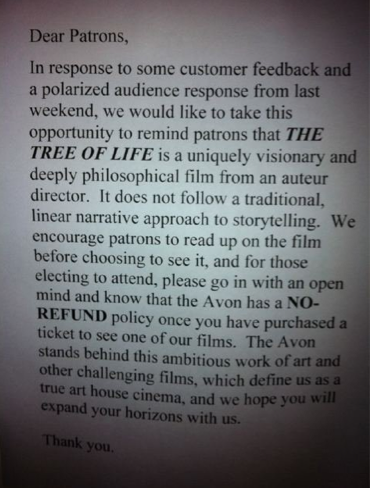
I've never written a movie critique before, but after watching the Tree of Life for a third time, I'm feeling particularly inspired. Sure there are many movies that some people like and some people don't (i.e. Saw VI), but never before have I experienced such a radical degree of polarization over a film. After arriving home from the second viewing, a neighbor staunchly commented that it was the worst movie she had ever seen. How's that for a movie review? Other people I know have snored their way through it and even left the movie theater in extreme consternation - partly because the theater staff wouldn't provide a refund. On the other hand, there is a certain type of people that has been moved to tears and profoundly affected by the emotional and existential significance of the subject matter. But how can this extreme contrast exist? How is it possible that we lie on such opposite ends of the spectrum of internal experience? I use the term experience because even if one doesn't understand the film the first time through, one is still capable of feeling its effect.

In other words, you don't have to fully understand it to be significantly moved. But how are we being moved exactly? What aspect of us is being moved? Could it be worthwhile to explore this? Could it be worthwhile to find out how to access this state more often? So what exactly is this state (for lack of a better term)?

Friday, August 12, 2011

Meditation: How to do it


Chaos is a friend of mine
-Bob Dylan

Before traveling to Thailand to learn meditation, I had no idea that my friends and family would be interested in ever practicing it. Since that trip however, I've had the pleasure of showing it to loved ones in various cities, including new friends here at Harvard and MIT. We are all motivated to learn meditation by something, perhaps curiosity at first, perhaps because we feel there is something missing from the way in which we experience daily life, perhaps we've come across a significant life event that becomes unmanageable, or perhaps it's due to something else. Whatever your motivation, below are a set of simple instructions (as simple as I could make them) that will show meditation to anyone willing to spare 5 minutes of their day.

I hope you find it useful.

Wednesday, August 10, 2011

The Grandest Illusion

The great obstacle is always the representation and never the reality
- Etty Hillesum

Preconceptions and misconceptions have engulfed the concept of meditation. Some people believe it's tied to Buddhism and cannot be detached from archaic supernatural beliefs. Others believe it's simply a tool to relax and reduce rampant stress levels in the mind and body. Still others who ponder it a bit more deeply - though still erroneously - argue that it detracts from our very human ability to experience the full spectrum of emotions. One common theme seems to unite the people who believe any or all of these things however - none of them have ever truly meditated. So what is it really about then?

It is about dispelling an illusion - the illusion that our subjective experiences are equivalent to objective reality.  

Say what?

Tuesday, July 19, 2011

Opening the Mind


Know Thyself
- engraved at the Temple of Apollo at Delphi

Many civilizations have regarded self-knowledge as the catalyst and indicator of wisdom. The path to self-knowledge is self-examination, but that is no longer a component of our education system as it once was. This is unfortunate by any account. In our modern westernized world, self-examination seems to have been limited to the areas of interpersonal counseling and few others.

Tuesday, July 5, 2011

The White Flag Hypothesis (2 of 2)


It is only after we have lost everything,
That we are free to do anything.

Underlying every human experience, mine and yours, there is a hidden but ever-present psychological struggle with existence itself. As we all know but seldom discuss, there is no way to win this struggle – we can’t help that our consciousness will cease to be at some point. Maybe sooner, maybe later. Given the futility and stress inherent to this phenomenon, we’ve become quite adept at hiding this primal dilemma of human life. The better we hide it or pretend it doesn’t exist, the better off we will be. Or so we think.

Sunday, July 3, 2011

The White Flag Hypothesis (1 of 2)


If you young fellows were wise, the devil couldn't do anything to you, 
but since you aren't wise, you need us who are old.  
- Martin Luther

As people age and the end of life comes clearly into view, something weird and interesting happens in the brain. Call it a "cognitive shift" or transcendence for now. This "shift" happens not only to old folks; but also to people who are afflicted by a terminal illness, experience the death of a spouse/child/best friend/sibling/parent, suffer an intense life-threatening accident, lose all of their possessions and/or wealth, experiment with psychedelic drugs, etc. (geez, all the cool stuff right?). See my previous post for some real world anecdotes. In essence, these events act like powerful psychological triggers in the brain, often resulting in a wildly transformative shift away from current views of ourselves, of other people, of deeply held values or beliefs, and of our very understanding of existence. Whew!

Sunday, June 26, 2011

The View from Outside


If we concern ourselves with meaning, society provides us with little direction.

I've always been curious, perhaps uncommonly so. When I was about 12 or 13 years old, I remember wanting to conduct an experiment interviewing older people who were nearing the end of their lives - say, 80 years or older. The setting wouldn't matter (nursing homes, family homes, in a cabin in the forest, etc.) but mental clarity certainly would. The main question I wanted to ask them was, "Having lived a 'full life' and possessing more wisdom than most, what would you say are the best ways to spend one's time?" In other words, "What truly matters?" I always had an underlying feeling that the various life pursuits advocated by family, school, and television were cleverly constructed distractions from what truly matters. The real answer to that question may produce a considerable degree of anxiety, but I figured these old wise folk - with less concern for social constructs - could shed some light on it.

Monday, June 13, 2011

Wheel of Values (research series)


The greatest virtues are those which are most useful to other persons.  - Aristotle

Here's an intriguing psych/sociological finding that's caught my attention recently; the initial question is: what values are embedded in our brains by the society we grow up in? It's difficult and perhaps a little unfair to judge an entire social system negatively off the bat, but if we break the system into the human values it advocates among its inhabitants, we can more fairly and accurately evaluate the subjective "goodness" of the system based on these individual values.

After an in-depth analysis spanning a couple of decades and tens of social scientists, a list of 9 universal human values was compiled. Here they are:

Conformity/Tradition: restraint of actions, inclinations, and impulses likely to upset or harm others and violate social expectations or norms.

Security:  safety, harmony, and stability of society, of relationships, and of self (social order, family security, national security, reciprocation of favors, clean, sense of belonging, healthy).

Power: attainment of social status and prestige, and control or dominance over people and resources (authority, wealth, social power, preserving my public image, social recognition).

Achievement: personal success through demonstrating competence according to social standards (ambitious, successful, capable, influential).

Hedonism: pleasure or sensuous gratification for oneself (pleasure, enjoying life).

Stimulation: excitement, novelty, and challenge in life (a varied life, an exciting life, daring).

Self-Direction: independent thought and action such as choosing, creating, exploring (creativity, freedom, choosing own goals, curious, independent).

Universalism: understanding, appreciation, tolerance, and protection for the welfare of all people and for nature. This contrasts with the narrower focus of benevolence values.

Benevolence: preservation and enhancement of the welfare of people with whom one is in frequent personal contact (helpful, loyal, forgiving, honest, responsible, true friendship, mature love).

The resulting pie chart was named the circumplex model of values. In this model, the values (represented by slices of the pie) that are closer to each other share similar structures and go hand in hand, meaning that they are pursued together (i.e. Achievement and Power). Theoretically, our pursuits are concentrated in one contiguous area of the chart, and we cannot scatter our pursuits in opposing areas. In fact, the values opposite each other are incompatible and extremely difficult (if not impossible) to pursue simultaneously (i.e. Achievement and Benevolence). Here is the chart:


Circumplex model of values, Schwartz (1992).

So now, what values does our society encourage? It may be of little surprise that free market capitalistic societies promote the values of Achievement, Power, and Security above others. What is surprising, at least to me, is that the pursuit of these values is incompatible with the pursuit of the values Self-Direction, Universalism, and Benevolence. You can't pursue Power while pursuing Universalism. You can't pursue Self-Direction while pursuing Security. You can't do both. You have to choose.

The foundational tenets of our society (i.e. self-interest, competition, financial success, and materialism) have allowed the generation of great wealth and alleviated certain problems facing humanity - undoubtedly so. However, it is important to remember that these aims conflict with and undermine pursuits long thought by psychologists to be essential to individual and collective well-being. These include helping the world be a better place, having committed, intimate relationships, and feeling worthy and autonomous (Kasser et al., 2007).

References:
Schwartz, S. H. (1992). Universals in the content and structure of values: Theory and empirical tests in 20 countries. 
In M. Zanna (Ed.), Advances in experimental social psychology, (Vol. 25) (pp. 1–65). New York: Academic Press.

Kasser, T., Cohn, S., Kanner, A.D., Ryan, R.M. (2007). Some Costs of American Corporate Capitalism:
A Psychological Exploration of Value and Goal Conflicts. Psychological Inquiry, 18 (1), 1-22.